 Jonathan Lopez
Are Your Woodland Hills Listing Photos Legal Now? California's New Disclosure Law
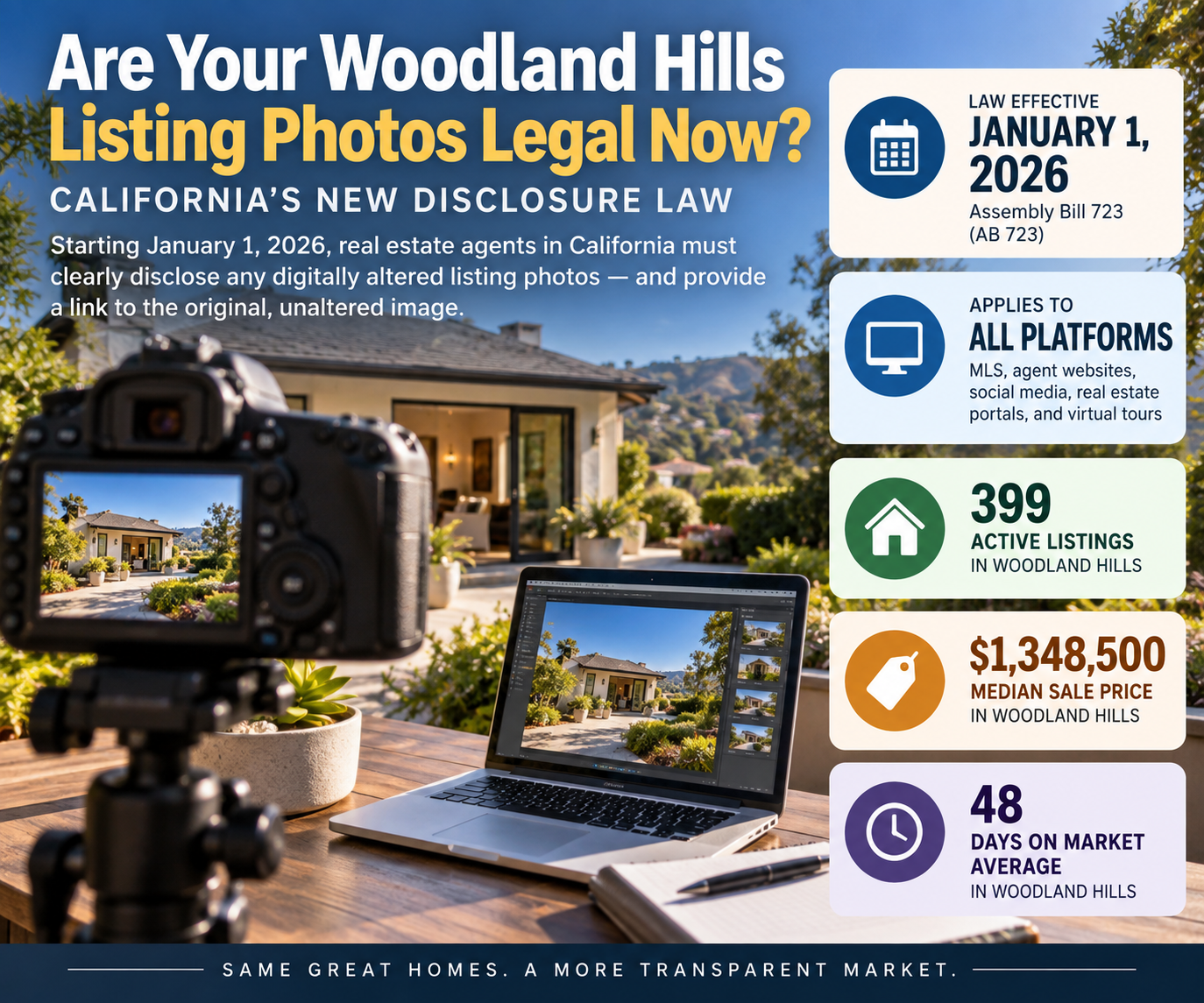
If you're getting ready to list a home in Woodland Hills, there's a new item worth adding to your pre-listing checklist that has nothing to do with staging furniture or fixing the driveway crack: your listing photos themselves now have to follow a new California disclosure law.
What Changed, and When
Starting January 1, 2026, California's Assembly Bill 723 added a new requirement to the Business and Professions Code. Any real estate broker or salesperson, or anyone acting on their behalf, who uses a digitally altered image in an ad or promotional material for a property sale has to include a clear, conspicuous disclosure right on or next to that image, along with a link, URL, or QR code to the original, unaltered photo. If the agent controls the website where the ad appears, that unaltered image has to be posted there directly, not just referenced somewhere else.
This isn't limited to the MLS. The law's language is intentionally broad: it covers personal agent websites, social media, real estate portals, and virtual tours. Anywhere a buyer might see the photo before deciding to make an offer, the disclosure requirement follows.
What Actually Counts as "Altered"
The law draws a specific line, and it's worth knowing exactly where it falls. A digitally altered image is one changed through photo editing software or AI to add, remove, or change things like fixtures, furniture, appliances, flooring, walls, paint color, landscaping, or the home's facade, along with anything outside the property that shows up in the photo: neighboring structures, utility poles, streetlights, or views through windows.
What doesn't count: routine adjustments like lighting correction, sharpening, white balance, color correction, straightening, cropping, and exposure. If the edit doesn't change what the property actually looks like, no disclosure is required. If it does, disclosure is mandatory, whether that's greening dead grass, adding water to an empty pool, removing a neighbor's parked car, or virtually staging an empty living room with furniture that doesn't exist.
Why This Has Real Teeth
This isn't a soft guideline. California's Department of Real Estate can pursue regulatory discipline against a broker or salesperson's license for violations. Beyond that, there's civil liability exposure: if a buyer, particularly an out-of-area, relocation, or investor buyer who doesn't physically walk through a home before making an offer, later claims they were misled by an undisclosed altered photo, that's a misrepresentation claim with real legal weight behind it. In cases of willful violation, it can even rise to criminal exposure, since a willful violation of California's Real Estate Law has long been treated as a crime. "We thought the edit was normal" isn't a legal defense once the statute spells out exactly what does and doesn't require disclosure.
Why This Matters If You're the One Selling, Not the One Holding the License
You might reasonably ask why any of this is your problem as a seller rather than your agent's. Here's the honest answer: it becomes your problem indirectly. If your listing photos aren't properly disclosed and a buyer later raises a misrepresentation claim, that can complicate or delay your transaction, create legal exposure tied to your listing, and in a worst case put a signed deal at risk over something that was entirely preventable. An agent who already has a clean, built-in disclosure process isn't just protecting their own license, they're protecting the smooth path to your closing.
It's also a reasonable, low-stakes way to evaluate a listing agent before you sign with one. Asking directly, "how do you handle photo edits and AB 723 disclosure on my listing," is a fair, specific question that tells you whether an agent is current on the rules that actually govern how your home gets marketed, versus one who's still operating the old way and hasn't updated their process since January.
What This Looks Like in a Normal, Current Woodland Hills Market
None of this changes the fundamentals of getting a home sold well. Woodland Hills homes are currently averaging 48 days on market (up slightly from 45 a year ago), with a median sale price of $1,348,500 as of August 2026 and 399 active listings citywide. Good photography and honest presentation still matter enormously in a market like this. The point of AB 723 isn't to discourage professional photo editing, it's to make sure buyers know the difference between a lighting correction and a photo that's been meaningfully changed, so nobody shows up to a showing disappointed by a gap between the listing and reality. If you're weighing whether now is even the right time to list, that's a separate question worth working through with your agent alongside this one, similar to the timing considerations covered in whether to wait for spring or list now.
If you're planning to list in Woodland Hills, this is worth a five-minute conversation with whoever you're considering as your agent, before photos go live anywhere.
Frequently Asked Questions
When did California's new listing photo disclosure law take effect?
January 1, 2026. It's Assembly Bill 723, now codified as Section 10140.8 of the Business and Professions Code.
Does this apply to every listing photo, or just some of them?
It applies specifically to digitally altered images, meaning ones changed through photo editing or AI in a way that changes how the property actually looks, like removing or adding fixtures, furniture, landscaping, or altering the facade. Routine adjustments like lighting, cropping, and exposure correction don't require disclosure.
Where does the disclosure have to appear?
Right on or immediately next to the altered image itself, with a link, URL, or QR code to the original unaltered version. This applies everywhere a buyer might see the photo: the MLS, an agent's own website, social media, listing portals, and virtual tours.
What happens if an agent doesn't comply?
The California DRE can pursue license discipline. Agents also face civil liability exposure if a buyer claims they were misled by an undisclosed altered photo, and willful violations can carry criminal exposure since violating California's Real Estate Law has long been treated as a crime.
Does this affect listings that were already live before January 1, 2026?
The law itself doesn't directly address retroactivity, and the general legal expectation is that it applies to listings posted after that date. Re-listed or reactivated listings after January 1, 2026 should assume full compliance applies.
What should I ask my listing agent about this before I list?
Simply ask how they handle photo edits and AB 723 disclosure on your specific listing. A clear, confident answer is a good sign your agent is current on the rules that govern how your home gets marketed.
Getting ready to list in Woodland Hills? Let's talk through how your listing photos and marketing will be handled, before anything goes live.
Or call (818) 934-7576.